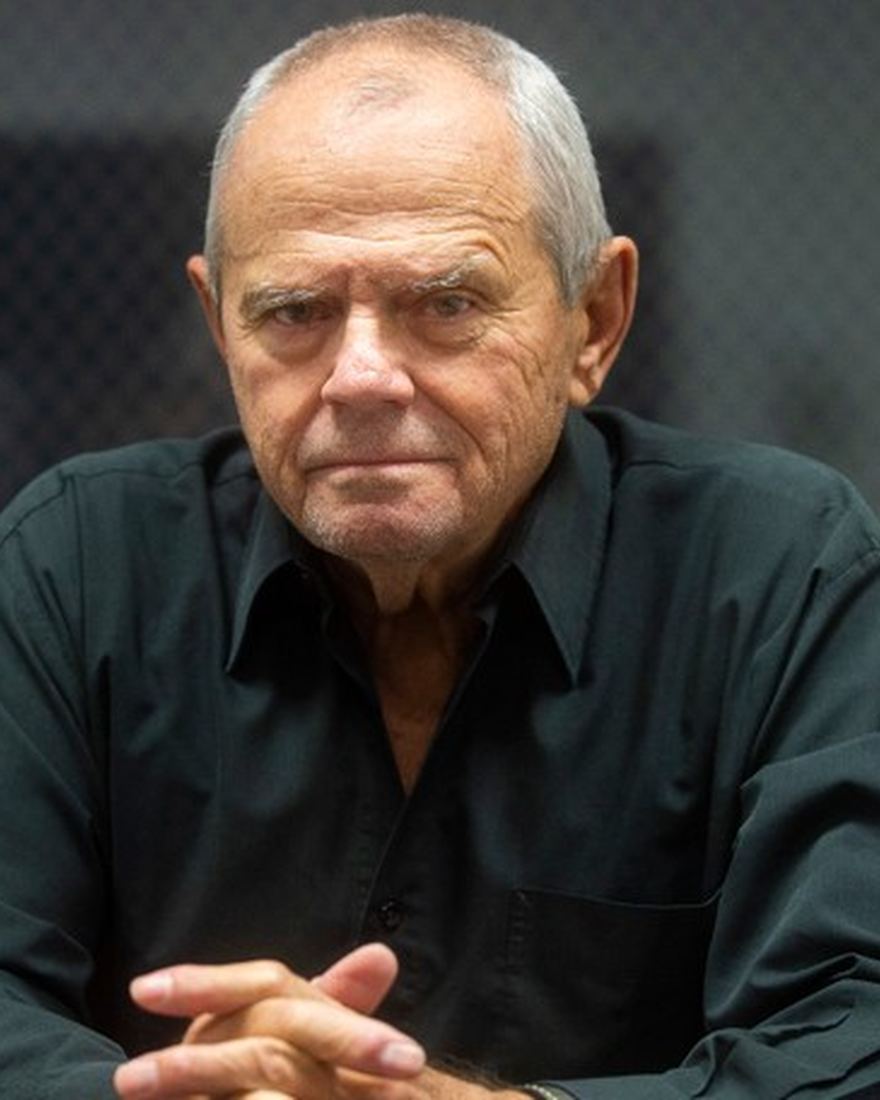
Milan Kňažko
Laureate of the 2018 edition
Milan Kňažko, actor, politician and one of the most prominent figures of the events of November ’89, was born on 28 August 1945 in Horné Plachtince. After attending a secondary school of civil engineering, he was admitted to the Theatre Faculty of the Academy of Performing Arts. He graduated in 1968 under the guidance of Professors A. Bagar and M. Huba. He then completed postgraduate studies at the University of Nancy in France.
Laureate profile
Milan Kňažko, actor, politician and one of the most prominent figures of the events of November ’89, was born on 28 August 1945 in Horné Plachtince. After attending a secondary school of civil engineering, he was admitted to the Theatre Faculty of the Academy of Performing Arts. He graduated in 1968 under the guidance of Professors A. Bagar and M. Huba. He then completed postgraduate studies at the University of Nancy in France.
After returning from France, he began an exceptionally successful acting career at Divadlo na Korze (Theatre on the Corso), which later merged with Nová scéna. From 1985 to 1990 he was a member of the Slovak National Theatre (SND). In the 1970s and 1980s Milan Kňažko appeared in many well-known films, such as Zajtra bude neskoro (Tomorrow Will Be Too Late, 1972), Život na úteku (Life on the Run, 1975), Choď a nelúč sa (Go and Don’t Say Goodbye, 1979) and Dobří holubi se vracejí (Good Pigeons Always Return, 1987)
He has also received many awards for his roles and acting performances.
Milan Kňažko was clearly opposed to the communist regime. When he was five years old, his father was arrested by the State Security (StB) and, in a fabricated trial, sentenced to thirteen years’ imprisonment for “espionage and subversion of the socialist state.” Milan Kňažko courageously withstood pressure from the security forces and never joined the Communist Party (KSČ). In October 1989, in protest against the policies of the communist regime, he returned his title of Artist of Merit.
He played a key role in civic life in November 1989, during the events that brought about the change from the communist regime to a democratic one. He signed the petition “Niekoľko viet” (“A Few Sentences”), which set out demands for civil liberties and was drawn up by Charter 77. He was one of the most prominent figures of the Velvet Revolution and of the November rallies. He co-founded and was a member of the coordination centre of Public Against Violence (VPN). He served as adviser to the President of the ČSFR, Václav Havel, in 1989–1990. During this period he was also a Member of the House of the People of the Federal Assembly of the ČSFR. From June to August 1990 he was a minister without portfolio. He then became Minister of Foreign Affairs, a post he held until 1991. After the 1992 elections he became Deputy Prime Minister of the Slovak Republic and Minister of Foreign Affairs, serving in this position until 1993.
After the anti-Mečiar opposition forces joined together and following the 1998 elections, he became Minister of Culture of the Slovak Republic, serving until 2002. In 2002 he withdrew from active politics.
From 2003 to 2007 he worked in the media as Director General of the new television station JOJ. Since leaving that position he has devoted himself to his original profession, and audiences can see him mainly on stage, but also in film and on television.
The President of the Trnava Self-Governing Region confers the Anton Srholec Freedom Award on Milan Kňažko for his contribution to culture and to the development of democracy in our country. At a turning point, which November ’89 undoubtedly was, he stood at the forefront of resistance to the communist regime. Through his unbreakable will to fight for freedom and democracy, he helped bring the Slovak Republic into the family of free nations of Europe. With his acting talent, Milan Kňažko enhances the reputation of the Slovak Republic throughout the world and is one of the most distinguished figures in the field of culture.