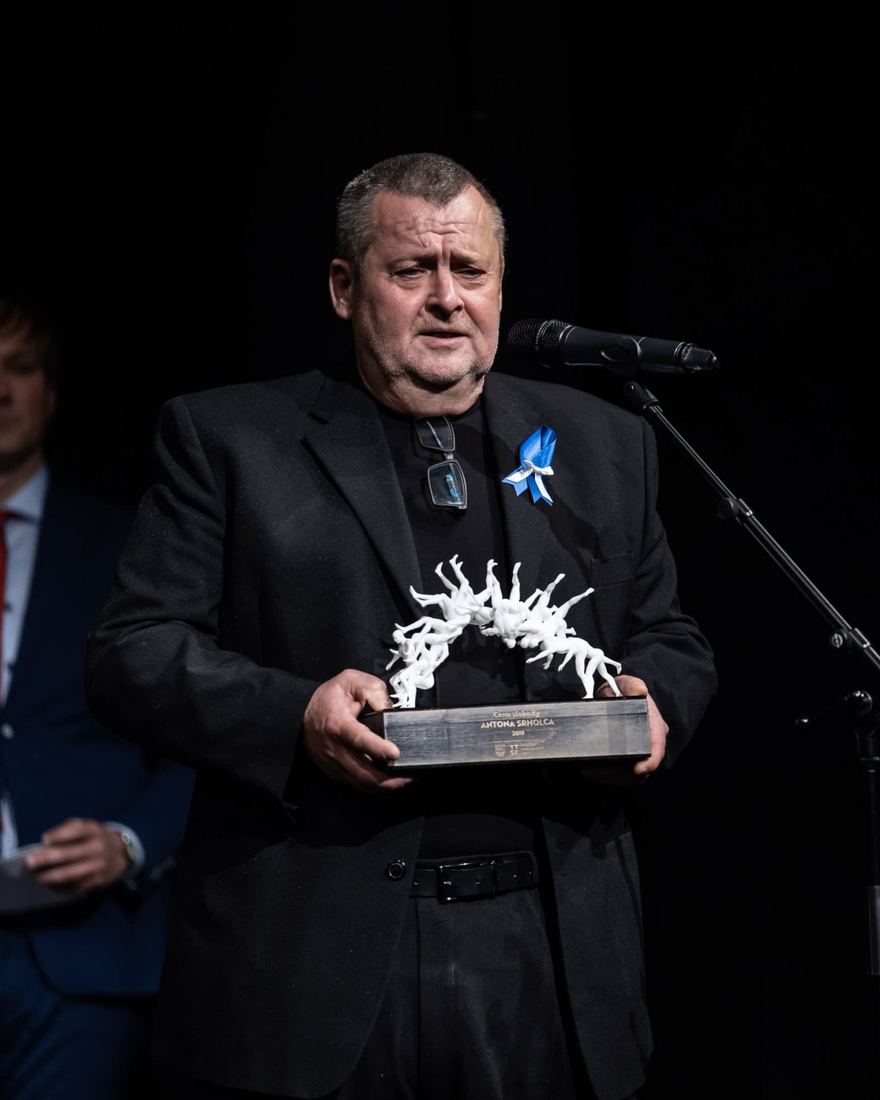
Ľubomír Navrátil
Laureate of the 2019 edition
Mgr. Ľubomír Navrátil, editor, journalist, translator, currently head of the Culture Department of the Dúbravka Borough Office, amateur revolutionary, woodcarver and basket weaver
Laureate profile
Mgr. Ľubomír Navrátil, editor, journalist, translator, currently head of the Culture Department of the Dúbravka Borough Office, amateur revolutionary, woodcarver and basket weaver
I was born in the maternity ward in Dunajská Streda at 7 o’clock on Saturday morning, 9 January, almost sixty years ago (born 9 January 1960), into a mixed Slovak-Hungarian family. With a bit of exaggeration, I like to say that on my mother’s side I am a Hungarian nationalist and on my father’s side a Slovak one. My later socialisation also took place in this amphibious environment, although right up to university I attended only Slovak kindergartens and schools.
At primary school I was a very good pupil, exactly in line with Lenin’s instructions, so I was admitted to the Pioneer organisation without any problems, where I rose as high as troop flag-bearer.
My grammar school years brought poorer grades, because my classmates and I had discovered more joyful sides of life than self-study. During those years, together with the artist Laco Teren, we published the magazine Mladosť (Youth), and at that time I started taking photographs and writing poems, mostly love poems. For example:
You’d surely stand there struck with awe
Without a single word to say
If I were hit by a trolleybus,
The number seventeen, let’s say.
Probably because of my all-round talents, I simply could not decide what to study. First I considered photography at FAMU, then I wanted to become a psychologist, but that year the programme was not open, so in the end I applied for Oriental studies – Indology. At the entrance exams, however, I was unable to explain the semantic difference between the Dravidian and Indo-European languages, so a professor advised me to educate myself for a few more years and then come back. At that time, though, people in such a situation faced two years of compulsory military service, so I went to the supplementary entrance exams for Russian and Hungarian, thinking I would vegetate there for a while and then choose something proper. In the end I took up the theory and practice of translation and finished my studies with a slight delay. Immediately after my state examinations I joined the Tatran publishing house as an editor. I worked there for about seven years among a select group of educated women and men. The job had the advantage that it required consultations with authors, and so as not to disturb colleagues at work, the unwritten rule was that these took place in one of Bratislava’s cafés. That is how I met the later participants of the Velvet Revolution Peter Zajac, Jano Štrasser, Ľubo Feldek, Miloš Žiak, Peter Tatár and Mišo Horský, and through my classmate Laco Teren I got to know a whole generation of the young artists of the time. The Tatran editorial office was in the same building as the Madách publishing house, and thanks to that, as well as to my studies at the Department of Hungarian, I in turn got to know Hungarian intellectuals such as Károly Tóth, Laco Öllős, Laco Barak, Imre Molnár, Peter Hunčík, Laco Szigeti, Lajos Grendel, Norika Sándorová and József Berényi.
I do not like to talk about my role during the Velvet Revolution, even though for two years I was a professional district politician, chairman of VPN in Dunajská Streda. I consider freedom in all its forms to be the most important achievement of the political movements after 1989, as well as the fact that, although the lighthouse of the Velvet Revolution now flickers only faintly, it still from time to time brings the ship sailing into the unknown back onto a better course.
I do not think at all that I deserve this award more than the other participants in the revolution in the Dunajská Streda district, so I would like to symbolically dedicate it to all my friends who actively took part in those miraculous moments, at a time when we were not yet left-wingers and right-wingers, communists and capitalists, Hungarians and Slovaks. When we were simply people who longed for freedom...