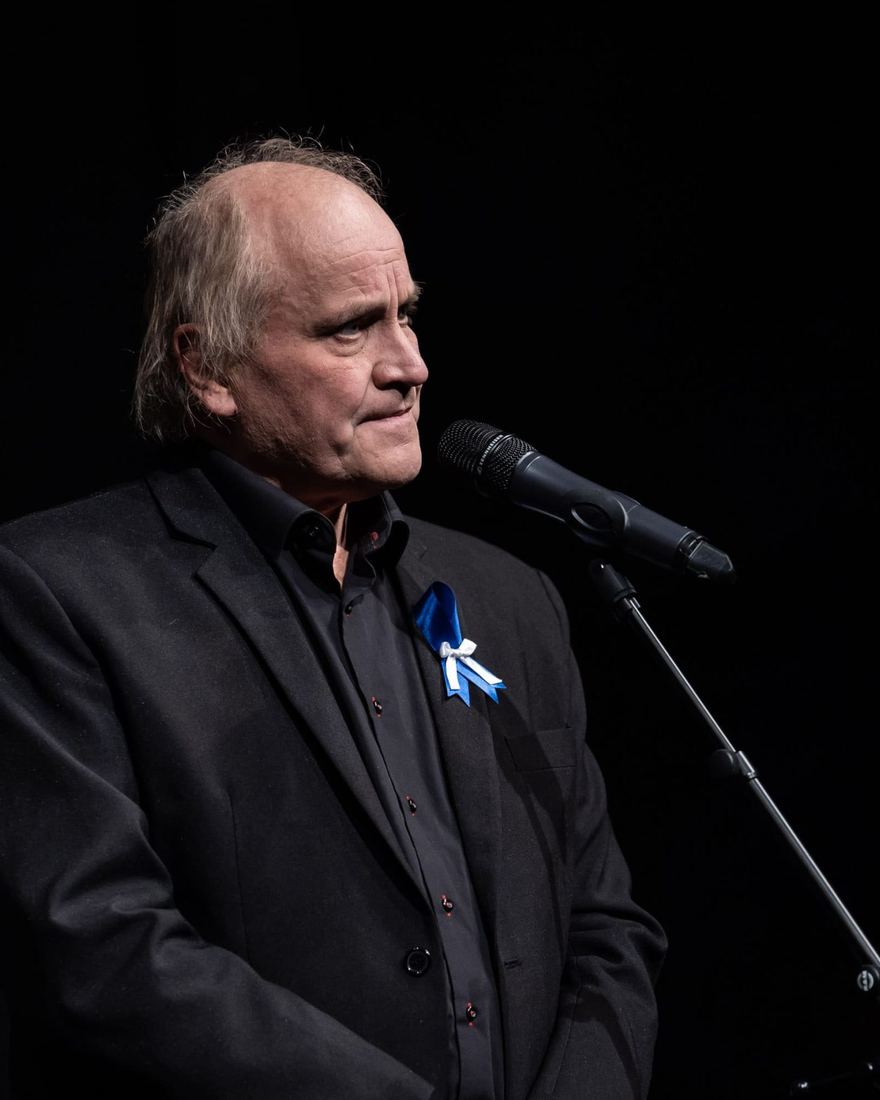
Michael Kocáb
Laureate of the 2019 edition
He was born on 28 July 1954 in Prague into the family of a Protestant pastor and a psychology graduate. His father, Alfréd, was one of the first signatories of Charter 77, as a result of which he was stripped of state permission to practise his profession and was subsequently forced to work as a stoker.
Laureate profile
He was born on 28 July 1954 in Prague into the family of a Protestant pastor and a psychology graduate. His father, Alfréd, was one of the first signatories of Charter 77, as a result of which he was stripped of state permission to practise his profession and was subsequently forced to work as a stoker.
In his youth Michal Kocáb chose a career as a musician, inspired among others by the exceptional Slovak artist Marián Varga, and he studied composition and organ at the Prague Conservatory. He worked as a musician, composer and politician. With the cult band Pražský výběr, which he founded, he operated on the borderline between the official and unofficial scenes and had a major influence on the development of rock music in Czechoslovakia. In 1980 he was charged with political provocation, and the criminal prosecution was ended only thanks to a presidential amnesty. Between 1982 and 1987 the band was banned.
In 1989, together with Michal Horáček, he founded the Most (Bridge) initiative, which mediated communication between the dissident and ruling structures and Prime Minister Adamec.
After the events on Národní třída in Prague on 17 November 1989, he was one of the founders of the Civic Forum movement and became one of its leading figures.
As a member of the crisis staff of the Civic Forum coordination centre, he led negotiations with the Chief of the General Staff of the then Czechoslovak Army, Miroslav Vacek, and the commander of the Western Military District, Mojmír Zachariáš, to ensure that the army would not intervene in the course of the Velvet Revolution. Just two days after 17 November 1989, he presented Prime Minister Adamec with, among other demands, the demand to secure the withdrawal of Soviet troops from Czechoslovakia. He subsequently led negotiations with representatives of the Soviet army, which had occupied Czechoslovakia since August 1968, on its withdrawal from Czechoslovak territory.
On 28 January 1989 he was co-opted into the Federal Assembly of the ČSSR, and a day later, on his proposal, Václav Havel was elected President of the Republic.
In the first free elections he was elected a Member of the Federal Assembly of the ČSFR, where he served in 1990–1991. As chairman of the federal parliament’s commission for overseeing the withdrawal of Soviet troops from Czechoslovakia, he bore key responsibility for the entire process of the occupying army’s departure. The last Soviet soldier left Czechoslovak territory on 27 June 1991. Having completed the task he had initiated, Michael Kocáb resigned his parliamentary seat in October 1991, left politics and devoted himself to music, business and consultancy. From 1993 to 2003 he also worked as an adviser to and associate of President Václav Havel.
In 1992, together with Pavel Tigrid, he organised a petition in support of the right of the citizens of Czechoslovakia to decide on a possible division of the Czechoslovak federation in a referendum (more than 2.5 million signatures).
From 2009 to 2010 he was Minister for Human Rights and National Minorities of the Czech Republic. Throughout his post-November career he has maintained an active interest in developments in Slovakia and has continually seized opportunities to bring our two nations together.