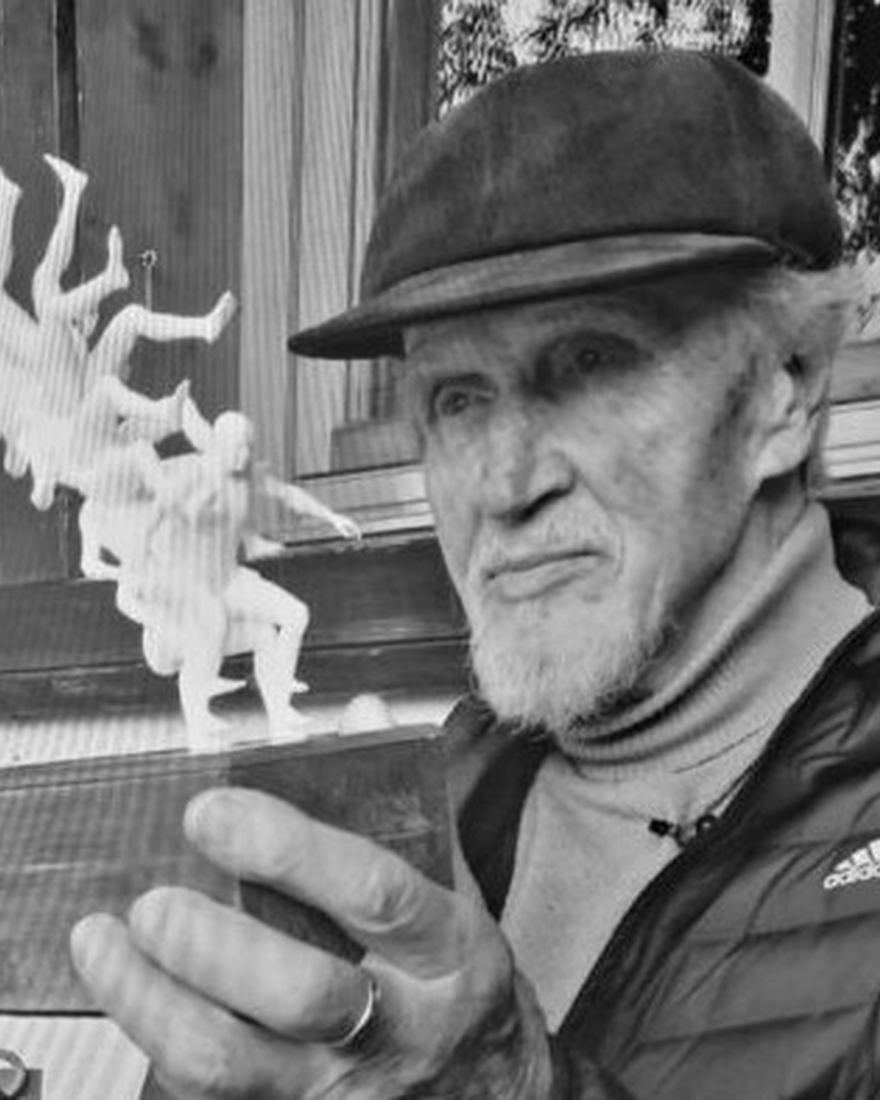
Michal Lošonský
Laureate of the 2021 edition
Writer, journalist and long-time editor at Radio Free Europe. Michal Lošonský was born in 1925 in Malé Brestovany. While still a student at the J. Hollý Grammar School in Trnava, he was involved in the Trnava theatre. He founded the permanent amateur theatre group Nová scéna (New Stage), with which he staged, among other things, the poetry programme Od poroby k slobode (From Bondage to Freedom). He fell out of favour with the communist regime, which targeted students who had supported the Democrats in the 1946 elections, and did not escape investigation by the secret police. In 1946 he went to Prague to study film directing, aesthetics and art history. Constant surveillance and his disagreement with the emerging regime led him to emigrate in June 1949, and he continued his studies at the university in Innsbruck, Austria. Together with other émigrés, he organised a self-help service for victims of Stalinism and helped persecuted people get across the border. From 1953 he worked at Radio Free Europe in Munich, first as a director and then as an editor under the pseudonym Michal Želiar. He is the author of many radio serials and programmes. He wrote poems, reflections and feuilletons for exile periodicals. As an editor, he contributed to the preparation of regular broadcasts. He also wrote film scripts and plays “for the drawer”.
Laureate profile
Writer, journalist and long-time editor at Radio Free Europe. Michal Lošonský was born in 1925 in Malé Brestovany. While still a student at the J. Hollý Grammar School in Trnava, he was involved in the Trnava theatre. He founded the permanent amateur theatre group Nová scéna (New Stage), with which he staged, among other things, the poetry programme Od poroby k slobode (From Bondage to Freedom). He fell out of favour with the communist regime, which targeted students who had supported the Democrats in the 1946 elections, and did not escape investigation by the secret police. In 1946 he went to Prague to study film directing, aesthetics and art history. Constant surveillance and his disagreement with the emerging regime led him to emigrate in June 1949, and he continued his studies at the university in Innsbruck, Austria. Together with other émigrés, he organised a self-help service for victims of Stalinism and helped persecuted people get across the border. From 1953 he worked at Radio Free Europe in Munich, first as a director and then as an editor under the pseudonym Michal Želiar. He is the author of many radio serials and programmes. He wrote poems, reflections and feuilletons for exile periodicals. As an editor, he contributed to the preparation of regular broadcasts. He also wrote film scripts and plays “for the drawer”.
Despite borders and other restrictions, he remained closely connected with his native country through his own work and engagement. During the totalitarian era, M. Lošonský connected the free world and the émigrés through his addresses and his work at Radio Free Europe. His many years of tireless work also included preserving valuable works of art and documenting the authentic life stories of Slovak émigrés and memories of the war years. He thus succeeded in assembling a remarkable collection of paintings and art objects, which he also presented in Slovakia after the borders opened.
In exile, Michal Lošonský also sought to communicate with people who could not return to Slovakia. In this way he formed friendships with many personalities with whom he corresponded or met in person. The result is a remarkable collection of preserved correspondence with prominent figures of cultural and social life, such as Koloman Sokol, Hana Ponická, Dominik Tatarka, Vincent Hložník and Karel Kryl.