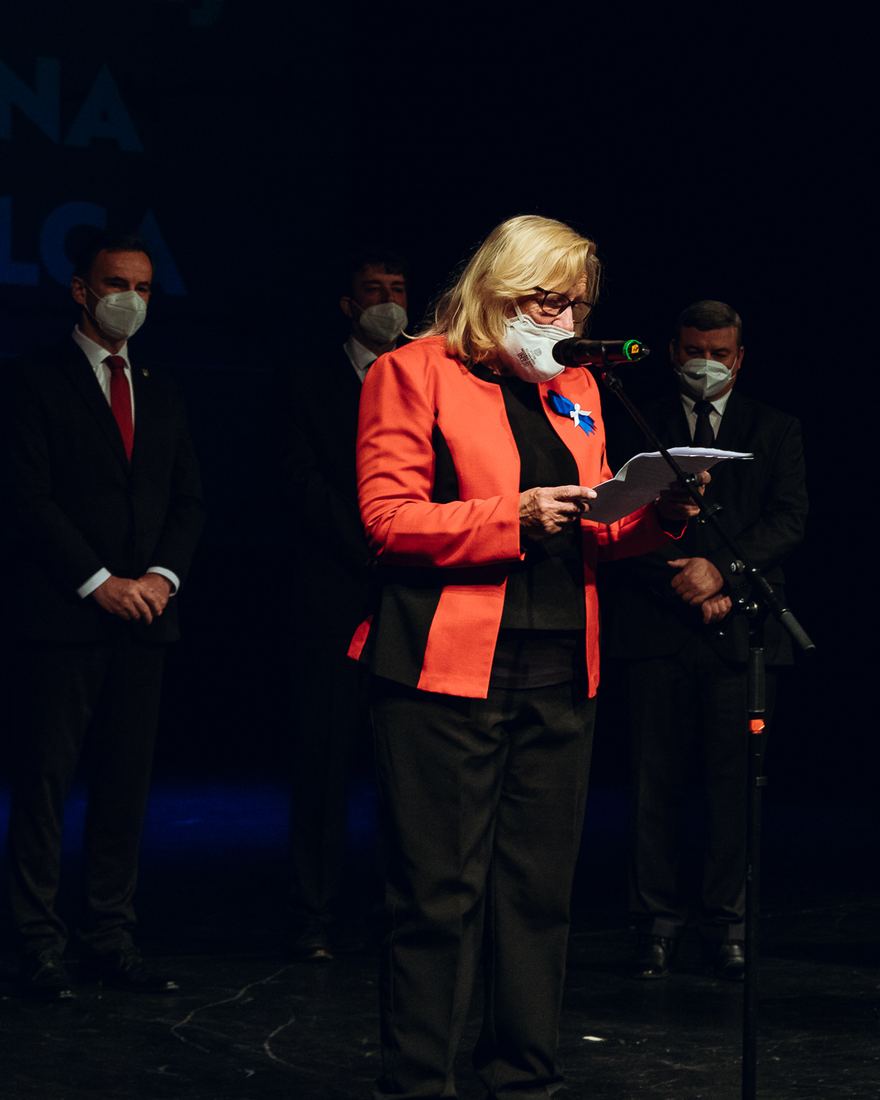
Hedviga Rozborová
Laureate of the 2021 edition
She was one of the two victims of the uprising of the inhabitants of Borský Sv. Mikuláš against the communist regime in 1949. She was born in 1904. In 1949 the communist regime in Czechoslovakia established the so-called Catholic Action, which was intended to bring priests and citizens together in a kind of pro-regime alternative to the Church. The project met with almost no response. The local dean, Msgr. Augustín Karmaš, likewise rejected it unequivocally and read out in church the bishops' pastoral letter condemning it, the reading of which the authorities had banned. On the day of the solemn ordination of two new priests, a communist agitator came to the village and urged the faithful to join the so-called Catholic Action. Those gathered stood up to him, and he was even physically assaulted.
Laureate profile
She was one of the two victims of the uprising of the inhabitants of Borský Sv. Mikuláš against the communist regime in 1949. She was born in 1904. In 1949 the communist regime in Czechoslovakia established the so-called Catholic Action, which was intended to bring priests and citizens together in a kind of pro-regime alternative to the Church. The project met with almost no response. The local dean, Msgr. Augustín Karmaš, likewise rejected it unequivocally and read out in church the bishops' pastoral letter condemning it, the reading of which the authorities had banned. On the day of the solemn ordination of two new priests, a communist agitator came to the village and urged the faithful to join the so-called Catholic Action. Those gathered stood up to him, and he was even physically assaulted.
In response, 40 members of the State Security (StB) were sent to the village with orders from the Central Committee of the Communist Party of Czechoslovakia to punish several people as a deterrent example. Fearing that the priest would also be taken away, between 1,000 and 1,500 people gathered in front of the church. Hedviga Rozborová then telephoned from the post office to Šajdíkove Humence and called on its residents to come and defend the priest as well. The state authorities responded by mobilising a three-hundred-strong force from the National Security Corps (SNB) and the People's Militia, who brutally beat the assembled people with rifle butts and truncheons. After dispersing the crowds in both villages, they beat anyone they came across. In total, 58 people were detained; the court sent 6 of them to prison, while the others were saved by a later amnesty.
Hedviga Rozborová was also taken into custody. The district prosecutor charged her with acting as a liaison with the inhabitants of Šajdíkove Humence and with being the “instigator” of a band of armed rebels, thereby committing the crime of sedition. Brutal interrogation and psychological pressure left her in such a critical state of health that she had to be escorted to a hospital in Bratislava, where she died on 6 January 1950. The cause of death was given as “inflammation of the middle ear”.
Hedviga Rozborová's name appears among the names of those persecuted and killed by the communist regime on the plaque of the Memorial to Political Prisoners in Ružinov Cemetery. By nominating her for this award, we also honour the courage and sacrifice of all victims of the totalitarian communist regime.